“Music making offers extensive exercise for brain cells and their synapses (connections). It would be difficult to find another activity that engages so many of the brain’s systems.”
— Weinberger, N., 1998
There is a rapidly mounting body of evidence for the health and wellness benefits of listening to, and especially making music. There can be few easier and more accessible ways to enjoy making music than using hand drums and percussion to create spontaneous in the moment music, with no set rhythms to learn, and no wrong beats, and no mistakes.
Sustaining Rhythms uses the HealthRHYTHMS facilitation protocol at the core of all our Health and Wellness programs.
HealthRHYTHMS, a wellness model using drums and percussion
Remo HealthRHYTHMS® is a fun and evidence-based Group Empowerment Drumming program, guiding participants through a series of 10 steps facilitating social connection, communication and personal expression, and ensuring a healthy non-strenuous workout.
Neurologist Barry Bittman, M.D. and his renowned research team developed the HealthRHYTHMS protocol, and through clinical trials found that it significantly increased the disease fighting activity of circulating white blood cells (Natural Killer cells) that target cancer and viral-infected cells, and decreases levels of Cortisol, the stress hormone [link].
Another study found Recreational Music-Making (RMM) following the HealthRHYTHMS Protocol inspires creativity and bonding in long-term care residents [link].
Drumming for Healthy Ageing.
Today’s senior citizens are the baby boomers, not the kind of people to just sit around and play cards and bingo. They are active, forceful and ready to keep living a full life.
Making music is for your brain like what Circuit Training is for your body. Circuit Training involves moving from one exercise (machine) to another, to exercise and develop different areas of the body. Most activities only use a few areas of the brain at a time, however making music engages areas all over the brain simultaneously, in a symphony of activity.
ABC North Coast NSW reports on a group of seniors finding physical and mental well-being through weekly drum gatherings. Read more here: Byron Bay elders beat drum for social inclusion
Drumming for Mental Health
Mental health issues affect 1 in 5 Australians every year. Anxiety disorders are often the most common mental health challenge, followed by depression.
Conventional antidepressant treatment for mental health issues can often have an oppressive effect on sufferers, as people’s emotional responses are numbed and they become unable to experience highs as well as lows. Drugs fail to acknowledge the circumstances behind the individual’s depressive state. They attempt to treat the symptoms rather than the root cause, sometimes with unintended side effects.
Studies from the UK seem to have found an unlikely alternative, in group drumming.
A study by the Royal College of Music in London has found that a 10-week programme of group drumming reduces depression by as much as 38% and anxiety by 20% [link].
A preliminary study, published in Psychotherapy and Psychosomatics, and a controlled study, published in PLOS ONE, also revealed that a 10-week programme of group drumming can improve social resilience by 23% and mental well-being by 16% [link].
One theory as to why group drumming is so effective, is that the activity of producing music, together with the sense of community that the circle gave the participants, led to an increased feeling of fulfillment and gave them something to look forward to each week.
It is also thought that the process of actively making music releases beneficial neurochemicals, such as Dopamine, Serotonin and Oxytocin, without the often accompanying side effect of pharmaceutical antidepressants.
While drumming, alone may not be a cure for mental disorders, it may be a useful tool to assist in treatment, and perhaps reduce the levels, or need for some pharmaceuticals.
Drumming in Aged Care
Challenges for residents in aged care include being physically and mentally active, having a sense of belonging, purpose and social inclusion, and sometimes behavioral changes due to frustration at their changing limitations.
According to the Australian Institute of Health and Welfare, on 30 June 2018, 49% of people in permanent residential aged care had a diagnosis of depression, 52% had a diagnosis of dementia, and 86% had at least one diagnosed mental health or behavioral condition.
HealthRHYTHMS is the ideal model for use in aged care. It’s not a performance, nor a drum class. Its an engaging journey through making music with drums and percussion that carefully leads the group from playing the simple rhythms of their names, through group entrainment, non verbal motivational expression, and a mindful guided imagery meditation.
It is a mindful activity that can leave the resident in a state of calm, feeling more connected and empathic with others around them. It encourages them to move in ways they don’t in their everyday activities, exercises left/right hand co-ordination and simultaneously balances the right and left hemispheres of the brain.
Drumming also releases feel-good endorphins that help manage chronic pain.
Residential Aged Care Group
Amazing results as people are coaxed out of being watchers sitting on the sideline to fully engaged participants interacting with each other, making friendships and expressing themselves individually and collectively In the group.
Maree Pedaste — Occupational Therapist
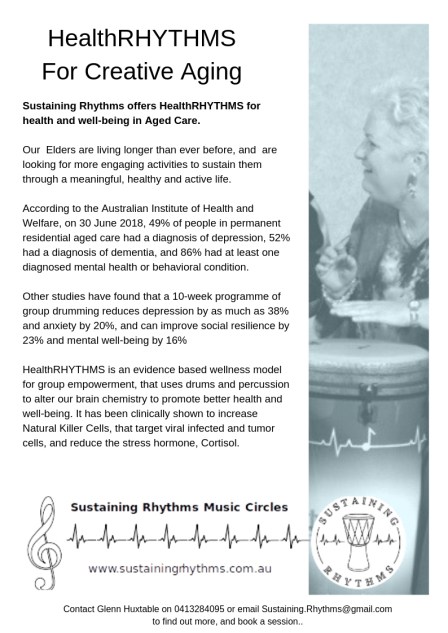
Click here to download our HealthRHYTHMS for Creative Aging Flyer PDF.
Drumming and Dementia
According to Dementia Australia, being physically active, mentally challenging your  brain and remaining socially active are important elements to maximizing brain health.
Listening to, and especially making music activates areas all over the brain, and has been shown to temporarily ease symptoms of dementia and Parkinson’s Disease.
Most Alzheimer’s patients typically kеер their hеаdѕ down. When drumming starts start, often their hеаdѕ begin tо rise, their eyes begin to move. They become aware of the instruments, of the grоuр, of the fасіlіtаtоr. And when they follow the instructions of the facilitator, to clap or tap, we rесоgnіzе this as a success before they even put a hand to drum. [link]
Click here and here, to read accounts of using HealthRHYTHMS with Alzheimer and Dementia patients.
Drumming an Parkinson’s Disease
… mood disorders such as depression and anxiety are clinical symptoms of Parkinson’s, just as are slowness of movement and tremor. In fact, up to half of all people with Parkinson’s may suffer from depression and/or anxiety at some point during the course of their disease. — The Michael J Fox Foundation for Parkinson’s Research.
People affected with Parkinson’s experience shaking, tremors, muscle stiffness and loss of balance. As we get older, memory loss, sleep deprivation and loneliness slowly creep into our daily lives. The good news is these symptoms and more can be improved through rhythmic drumming.
Researchers believe that depression and anxiety in Parkinson’s are due to changes in brain chemistry that are caused by a decrease in brain cells that create dopamine, important for regulating body movement. The same pathways also create serotonin, which regulates mood, appetite and sleep, and may be responsible for symptoms of depression and anxiety.
The rhythmic motion of drumming improves motor skills, develops muscle tone, and stimulates brain functions. Drumming also increases dopamine and serotonin levels, helping to create an overall healthy emotional outlook. In addition to that, the social aspect of drumming in a group can decrease stress levels, regulate blood pressure and improve sleep habits.
Click here to read an account of a drumming program for the Malaysian Parkinson’s Disease Association.
Drumming and MS
In people with multiple sclerosis (MS), the body mistakenly attacks its own myelin coating on their nerve cells, which triggers such symptoms as muscle weakness, chronic pain, coordination problems, memory loss and fatigue.
Because there’s no cure for multiple sclerosis, patients often incorporate alternative and complementary therapies, such as drumming and mindfulness, into their treatment plan.
Group drumming releases feel-good endorphins that help manage chronic pain, and builds social resiliency, reduces feelings of anxiety and depression, and bolsters the immune system.
Click here to find out more about drumming and MS.
Contact us to talk about booking HealthRHYTHMS sessions for your Corporate or Community Health and Wellness programs, or for Aged Care and Disability Care.
Videos
Overview of Remo HealthRHYTHMS Group Empowerment Drumming protocol
Example HealthRHYTHMS session.
Alex West Drum Stuff, Aged Care Drum Group
Treating dementia with drumming
Escaping Alzheimer’s with Bezzie Schmitt
 Sustaining Rhythms Music Circles